The story
Scheherazade and the Thousand and One Nights
Who the storyteller is, how the Nights grew over a thousand years, and what a dinner show in Hammamet borrows from the name.
Find my evening ↗Quick answer
Scheherazade is the narrator of the frame story that holds One Thousand and One Nights together: a vizier's daughter who keeps a king from executing her by telling tales that stop at dawn. The collection grew over centuries from Persian, Arabic and Indian material, and some of its best-known tales were added by its first European translator. The Hammamet show borrows the name for atmosphere; the booking page does not say it performs her story.
The Nights in brief
| Point | What the sources say |
|---|---|
| Frame story | A king, a storyteller and 1,001 nights of unfinished tales |
| Name | From Middle Persian Šahrzād, traditionally read as born of the city |
| Earliest trace | A ninth-century Arabic fragment titled Kitab Hadith Alf Layla |
| First European translation | Antoine Galland, in French, 1704 to 1717 |
| Tunisian footnote | The Breslau edition of 1825 to 1838 claimed a Tunisian source |
The frame story
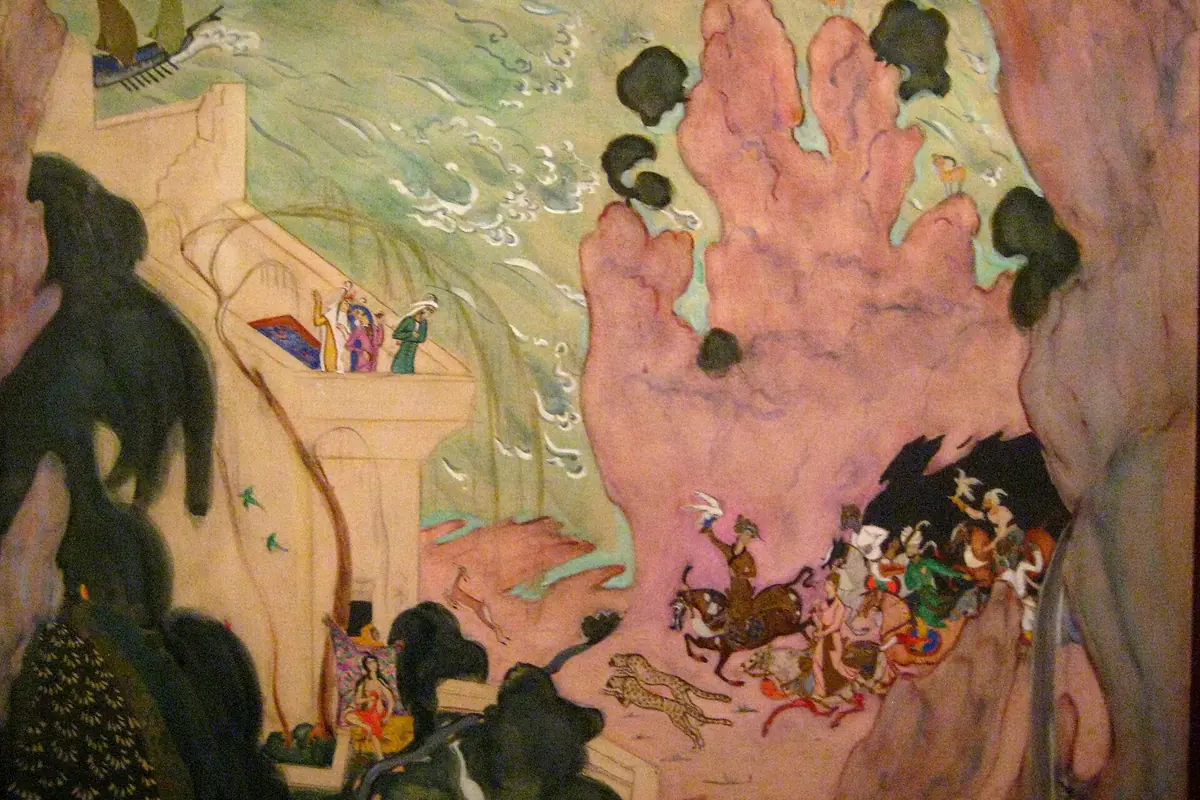
Wikipedia's account runs like this. King Shahryar, having discovered his first wife's infidelity, marries a new bride every night and has her put to death at dawn. The vizier's daughter, Scheherazade, volunteers. Each night she begins a story and stops at sunrise, so the king postpones her execution to hear the ending. Over 1,001 nights she tells tales of kings, merchants, lovers and jinn, until he gives up his violence and spares her for good. Endings vary between manuscripts, which is a useful reminder that the Nights was never one fixed book.
What her name means
The name comes from Middle Persian Šahrzād, which Wikipedia says is traditionally read as born of the city or daughter of the realm. Antoine Galland's French translation popularised the spelling Schéhérazade, from which most Western variants descend. The dinner show in Hammamet spells it Sheherazade, another Western rendering of the same name.
A collection that grew
The Nights is a composite, compiled in Arabic during the Islamic Golden Age from Persian, Arabic, Indian and Mesopotamian sources. Its frame story likely derives from a Persian work, Hezār Afsān, meaning a thousand tales. The earliest known fragment, from the early ninth century, was identified in the 20th century by Nabia Abbott and bears the title Kitab Hadith Alf Layla. The oldest manuscript with the complete frame story is the Galland Manuscript from the Syrian branch, written between about 1450 and 1593 and now in the Bibliothèque nationale de France.
Two Arabic traditions
Wikipedia distinguishes a shorter Syrian branch and a longer Egyptian one, with many tales added across the centuries. The first printed Arabic edition in an Arab country, the Bulaq edition of 1835, was based on the Egyptian tradition. The Leiden edition of 1984, edited by Muhsin Mahdi, is considered the most faithful critical text of the medieval Arabic version.
Galland and the tales that were not there
Antoine Galland's twelve-volume French translation, published from 1704 to 1717, was the first European version. It included Aladdin and Ali Baba and the Forty Thieves, which do not appear in the Arabic manuscripts; Galland said he heard them from the Syrian Maronite storyteller Hanna Diyab. In other words, two of the stories most people associate with the Nights arrived through a European book, a fact that sits oddly with the idea of a pure folk original.
A Tunisian footnote
Wikipedia records that the Prussian scholar Christian Maximilian Habicht worked with the Tunisian Mordecai ibn al-Najjar on the Breslau edition, published from 1825 to 1838. They claimed to be using a Tunisian manuscript, which al-Najjar later admitted was a forgery. The episode shows how much Europeans wanted a North African source for the tales, and how tangled their transmission was.
What a dinner show does with the name
A restaurant or evening show called Sheherazade uses her name as shorthand for hospitality, storytelling and the East. The booking page for the Hammamet evening describes an arabesque setting and a live performance, not a retelling of the tales, so go for the food and the entertainment and take the name as decoration.
Who this isn't for
Anyone expecting a theatrical staging of the Nights will not find it promised on the booking page. For the stories themselves, read a translation of the Nights.
Frequently asked questions
Who was Scheherazade?
The storyteller of the frame story, who tells tales for 1,001 nights to survive.
Are Aladdin and Ali Baba in the original Arabic?
Wikipedia says they do not appear in the Arabic manuscripts and that Galland said he heard them from Hanna Diyab.
Does the Hammamet show perform her story?
The booking page does not say so.
Sources